
DragonflyCats
Blood Type in cats
Short answer: cats have three blood groups, A (the most common), B (common in certain pedigree breeds) and AB (rare). Blood type matters in breeding: a type A or AB kitten that drinks the colostrum of a type B mother can develop neonatal isoerythrolysis, which is rarely treatable. That is why responsible breeders test their cats with a genetic panel before planning a litter.
There are three major blood groups in cats: A, B, and AB. Group A is the most common, but group B is also common in certain pedigree breeds. Group AB appears to be rare across all breeds. Blood groups are essential because they determine blood compatibility.
This is why it is important to test your cats using a genetic panel at a veterinary laboratory.
How can neonatal isoerythrolysis be prevented?
Because treatment is rarely possible, it’s much more important to prevent this condition from occurring in the first place.
It’s more common in pedigree cats, especially in breeds with a high occurrence of both type A and type B cats. In these cases, the blood type of the cats used for breeding should always be identified in advance. Several methods can then be employed.
- Only mate group B queens with group B toms, but sometimes it is impossible.
- Prevent Type A kittens from suckling colostrum from a Type B queen during the first 24 hours of life. Newborn kittens will need to be blood-typed using blood from the umbilical cord, and Type A and AB kittens need to be removed from the queen. These kittens will need to be bottle-fed for the first 24 hours (or placed with a Type A foster queen that is producing milk). After that, it’s safe to put them back with the queen, as they will no longer be able to absorb antibodies.
How are affected kittens treated?
Once the kitten has absorbed the antibodies, it’s difficult to treat the problem.
- If detected in the first few hours of life, the kitten should be removed from the queen for the remainder of the first 24 hours to prevent further absorption of anti-A antibodies from the colostrum
- It may be possible to transfuse the kitten. However, the problem is often recognized too late for this to be helpful, and there are very real, practical difficulties in providing a blood transfusion to a newborn kitten.
What to look for in affected kittens
The kittens will be born normally, but soon after they suckle, any group A (or AB) kittens in the litter may begin to show signs of illness.
The severity of the signs varies, likely depending mainly on how many anti-A antibodies the kitten has absorbed. Signs include:
- Sudden death with no warning signs in some kittens.
- Most affected kittens will appear to ‘fade’ over a few days – they will stop suckling from the queen, become weak, often appear pale, and may become jaundiced (yellow)
- Affected kittens usually pass red-coloured urine due to the presence of hemoglobin (released from the breakdown of red blood cells) in the urine
- Mildly affected kittens may show few signs, but the tips of their tails (and sometimes ears) may gradually die off. This is because antibodies against the red blood cells may prevent normal circulation to the extremities.
- Some kittens are unaffected, showing no signs of illness
Explanation
What are the risks to a cat if blood groups are incompatible?
Blood transfusions are sometimes necessary for cats and can be life-saving. However, transfusion reactions can pose serious risks. Cats with type A or B blood must receive a donation from a cat of the same blood group, or they risk a potentially life-threatening reaction.
Blood group B cats have high levels of anti-A antibodies in their blood. Antibodies are part of the immune system, so if a type B cat receives blood from a type A donor, this could trigger a severe (and potentially fatal) reaction because the immune system would recognize the type A blood as ‘foreign’ and attack it.
Some group A cats also have anti-B antibodies, so they may experience severe reactions if given incompatible blood.
Neonatal isoerythrolysis in Kittens
Any antibodies present in a queen’s (female cat’s) blood will also be passed into her milk and colostrum (the first milk produced) if she nurses a litter of kittens. These antibodies will help protect the kittens against diseases during the early weeks of life.
While this is very beneficial for the kitten, it can sometimes lead to issues with blood group incompatibility. If the queen has blood group B, she will naturally have anti-A antibodies. If she mates with a type A tomcat, all kittens will be type AB. When they feed on the queen’s milk in the first 24 hours of life, they will absorb the anti-A antibodies.
The anti-A antibodies will then destroy the kitten’s red blood cells, as if there had been an incompatible blood transfusion. This condition, called neonatal isoerythrolysis, can be a significant cause of death in young kittens of certain breeds.
This disease does not occur in type B kittens born to a type A queen because type A cats have much lower levels of antibodies against type B blood cells and often have none at all.
Most cats naturally produce antibodies against blood groups they do not possess. Generally, cats with blood group B have strong antibodies against blood group A antigens, while cats with blood group A have weaker anti-B antibodies.
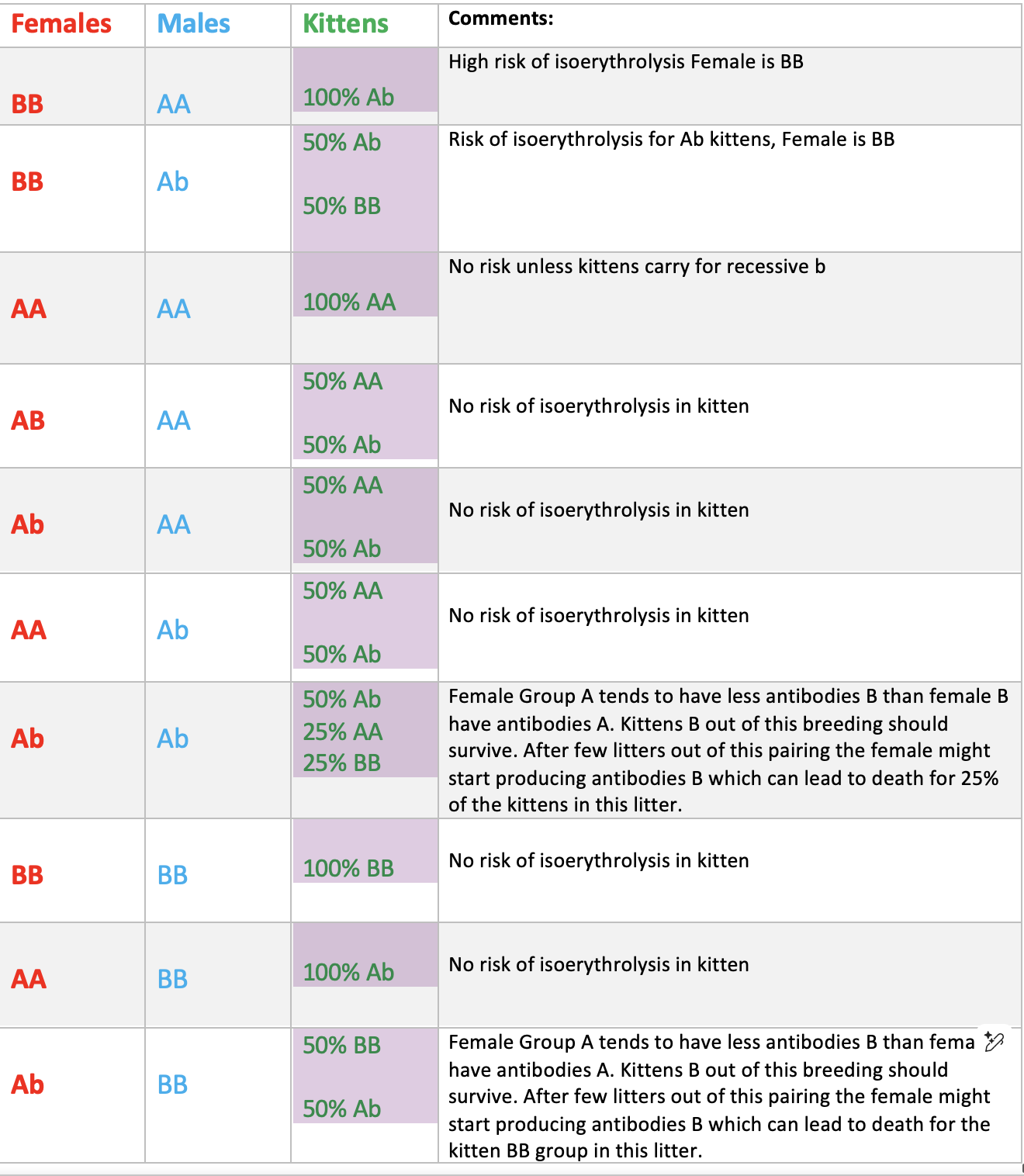
A mating between a female with blood group B (alleles b/b) and a male with blood group A (alleles A/A, A/a, or A/b) is highly likely to cause neonatal isoerythrolysis in any kittens with blood group A.
During the initial feeding of colostrum (first milk), the mother passes a large number of antibodies to her kittens, including anti-A antibodies. In kittens with blood group A, these anti-A antibodies attack and destroy their red blood cells, leading to a condition called neonatal isoerythrolysis. This phenomenon is similar to our Rh (Rhesus) system, although the antigens and antibodies involved are different.
This isoerythrolysis reaction can be fatal in kittens of blood group A, so it is not advisable to breed females of blood group B (gene alleles b/b) unless they are mated with a male of blood group B. Conversely, there is no risk in mating a female of blood group A with a male of blood group B, since, as mentioned above, antibodies against the antigens of blood group B are present at low levels in the blood.

